
You shouldn't have to figure out a healthcare system while you're inside it.
Nobody is explaining things in a way that makes sense. You can't tell whether the care is good or whether you're being taken for a ride. Being foreign makes all of it worse: the language, the culture, the way the place runs.
That isn't because you're doing something wrong. The hospital system in Indonesia wasn't built for you. It's a structural gap, and closing it is the whole of our job: we explain what is happening, we set out your options, and we make sure you understand every step.
We aren't going to walk in and tell you everything is fine, or manage your feelings, or pretend this isn't hard. We're going to give you clarity: what's happening, what it means, and what you can do about it. Once you have that, you'll find your own footing.
We answer between 8am and 8pm WITA, seven days a week. Outside those hours, send the message anyway. It is read first thing, and almost nothing in an Indonesian hospital is decided overnight.
You do not need to be a member. Most people who reach this page aren't.
From IDR 2,500,000: onboarding plus six days of coordination and the written hospitalization report. Full costs are further down this page.
What happens next, in order
A real person reads it
Tell us which hospital, what happened, and who the patient is. No form, no intake questionnaire. We will ask a small number of questions and we will tell you straight away whether we can help.
We get up to speed on the case
A case manager, who is a doctor, collects the records from the ward, reads what has actually been done so far, and works out what the plan is. This is the part you cannot do from a chair beside the bed.
You stop guessing
A daily written update in English. Someone to ask at any point during the day. Every decision explained before it is made, and every bill checked before it is paid.
The sequence above, spoken by the people who run it: what we can do fast, and what has to wait for the ward.
If you're reading this for somebody else
Most people who contact us are not the patient. They are a partner in the corridor, a son or daughter on a phone in another time zone, a friend who happens to be the one who speaks up.
You do not need the patient's permission to ask us a question, and you do not need to know any medical vocabulary. Tell us what you have been told and we will tell you what it means.
Where are you right now?
How much we can change depends almost entirely on how far along you already are. Two doors close early, and they close hard: once a hospital is chosen your options narrow, and once the patient is registered the pricing is fixed. We would rather tell you that now than explain later why we couldn't do more.
What is still open
Everything. Which hospital. Which surgeon. How the patient is moved and whether they are stable enough to move at all. Whether this should be treated in Bali or somewhere else. And critically, the price, because pricing is agreed at registration and cannot be renegotiated afterwards.
This is also the rarest call we get, because at this point most people don't yet know that a decision is being made on their behalf.
What we do in the next few hours
- Read the imaging and the notes, and say whether the facility and the surgeon actually match the injury.
- Name the specific surgeon we would want, and a second choice, with the reasoning.
- Arrange safe transport: immobilization, ambulance, and the imaging files traveling with the patient.
- Get the price agreed before admission, at our negotiated rate.
- Tell you if the honest answer is that this should not be happening in Indonesia.
What is still open
The operation itself. We can request a pre-surgical conference, get the plan explained properly and in writing, obtain a second opinion, and screen the anesthesia risk against the patient's history, which is a consistent gap in standard pre-operative protocol here.
What is generally closed: the pricing, which was fixed at registration, and usually the surgeon, though not always. Where there is a real mismatch between the injury and the operator's subspecialty, a formal request to change surgeon can succeed, and we have made those requests.
What we do today
- Request a pre-surgical conference and attend it with you.
- Set out the alternatives to the proposed procedure, including waiting.
- Screen anesthesia risk: allergies, prior reactions, conditions warranting caution.
- Arrange a second opinion, locally or internationally, fast enough to be useful.
- Tell you honestly whether transferring is worth what it costs at this point.
Being straight with you
The surgery is done. The treatment plan and the price are both locked, and nothing we do will change either. Most of what is left is riding out recovery and getting discharged well, unless there is a genuine clinical concern or a further procedure is needed, in which case a transfer comes back onto the table and we will say so.
So we will not pretend to be rescuing anyone. But the problem at this stage is rarely the medicine. It is that nobody has explained anything, the days are long, and everyone is frightened and increasingly angry. That is a real problem and it is one we can fix.
What we do from here
- Read the whole record and explain, in English, what has actually been done and why.
- A written update every day, so nobody is waiting on a corridor conversation.
- Watch for complications, and escalate properly if one appears.
- Manage discharge so it happens when it should, and check the bill line by line.
- Produce the hospitalization report, the document that travels home with you.
From IDR 2,500,000: onboarding, six days of coordination and the written report. Private 24-hour nursing and other support can be added at any point.
A clinical summary, written for the family
The hardest moment in a hospital case is rarely the surgery. It is the hour beforehand, when someone asks you to consent to something you do not understand and everyone else in the room has already made up their mind. This is the document we write for that hour, and it is addressed to whoever is doing the worrying rather than to the patient.
The one below is real: a displaced femoral neck fracture in a 37-year-old man, admitted to a hospital in North Bali, 19 March 2026. Redacted at the patient's identity and nowhere else.
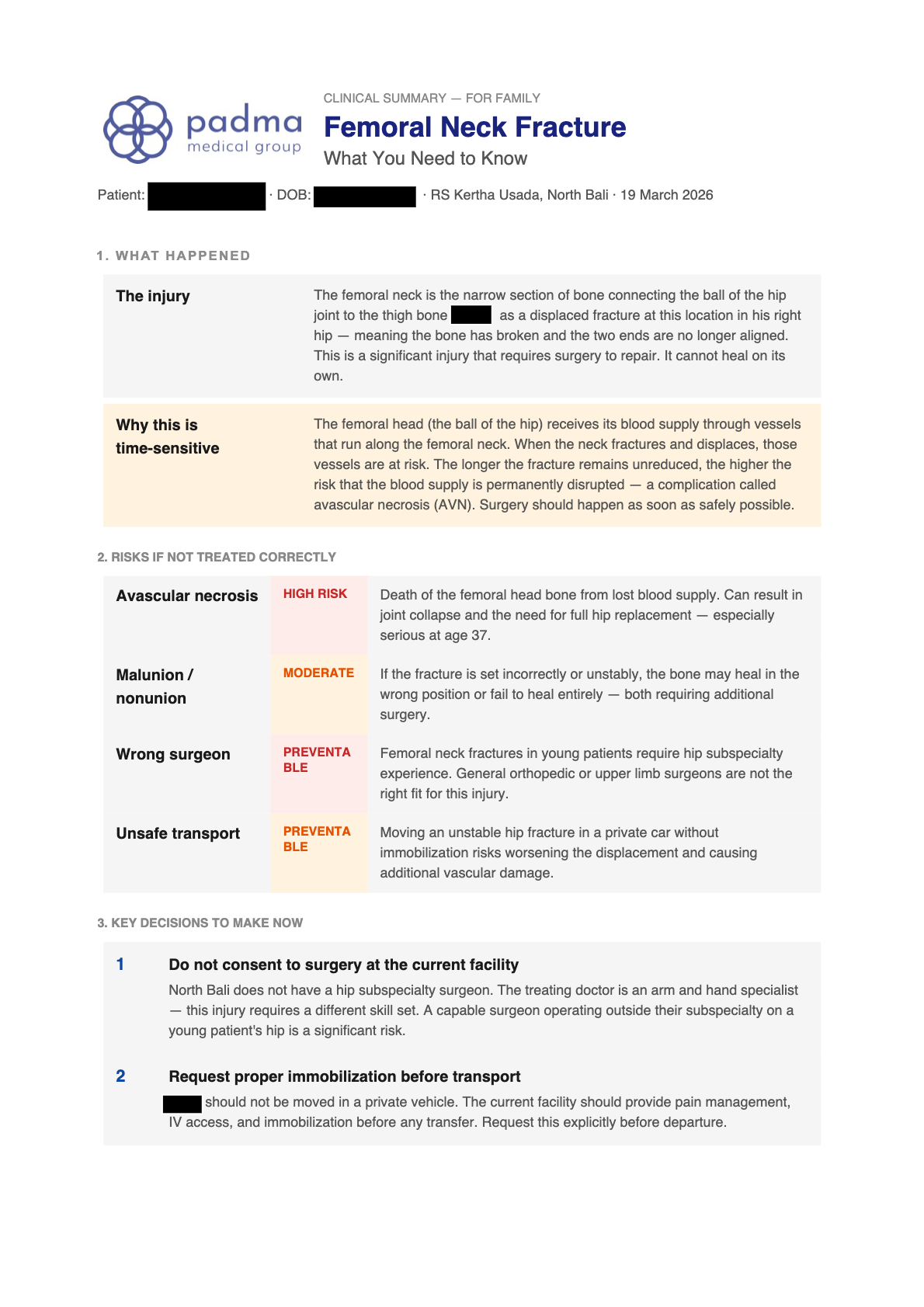
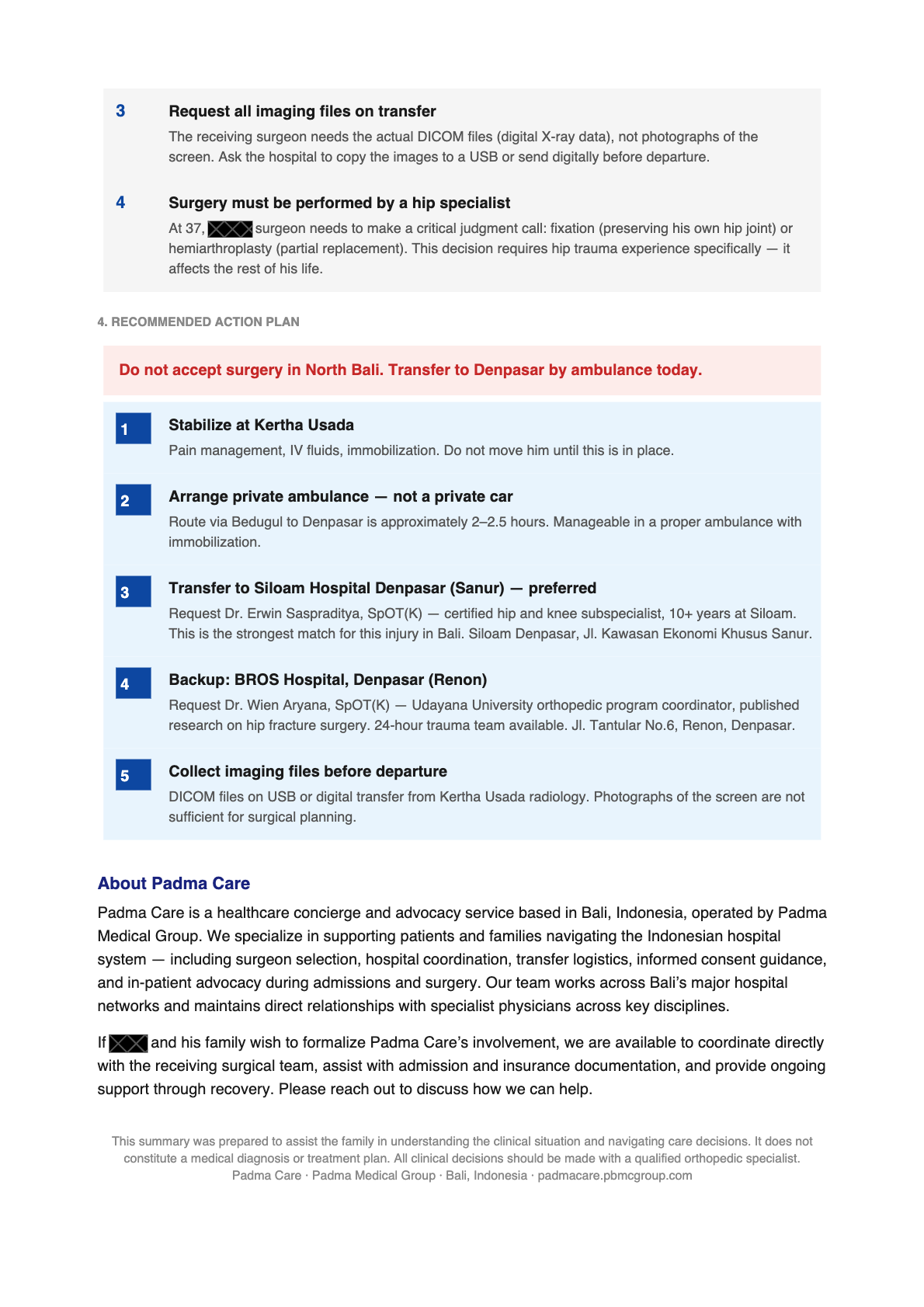
This is not a second opinion in the usual sense, and it does not overrule anyone. It puts the decision back into a form the family can actually weigh, which is the thing that gets taken away the moment somebody is admitted. What they then chose to do with it was entirely theirs.
What it can take to get the right specialist into the room
The family had already been given the name of a good surgeon by someone they trusted, and he was a good surgeon. He was not, however, a subspecialist in the thing that had actually gone wrong, a distinction that is invisible from outside the profession and decisive from inside it.
We asked that he at least consult the relevant subspecialist working alongside him before proceeding. We asked carefully, because this is not a request that is ever welcome. He told us he had done so.
We then spoke to that subspecialist directly. He had never been approached.
We told the family what we had found and let them decide what to do with it. They submitted a formal request to change surgeon. The pre-surgical conference took place as it should have, and the operation was carried out by the right specialist, at a hospital that had not been our first recommendation, because by that point that was where everything had already been set in motion.
Nothing in that sequence was exotic. A referral passed along inside a friendship, a case sitting just outside somebody’s subspecialty, and no mechanism anywhere in the system for noticing either. That is the gap. It is not a failure of medicine and it is not anybody's bad luck. It is simply that nobody is checking, and the patient is the last person in the building equipped to start.
Five windows, and what we do in each
Nearly every hospital case in Bali follows the same five stages. Knowing which one you are in tells you what is about to be decided, and what to ask before it is.
What this costs, in full
You are about to make expensive decisions under pressure, so here is every number before you ask for one. Hospital and doctor fees are separate and are charged at the rate we have negotiated. We add nothing to them and take no commission from anyone.
| Service | What it is | Price |
|---|---|---|
| Advocacy onboarding | One-off. Getting fully up to speed on a case we have not seen before. | IDR 1,000,000 waived for members |
| Inpatient coordination | The core service. Daily updates, expert review, options, bill vetting, guidance. | IDR 250,000 per day |
| Hospitalization summary report | The whole admission reconciled into one English document: resumes, scans and prescriptions, with sources listed. Part of the six-day minimum; taken on its own it bills as one coordination day. | IDR 250,000 counts as one day |
| Inpatient nursing | One daytime shift, eight hours, at the bedside. | IDR 800,000 |
| 24/7 inpatient care | Continuous medical oversight with direct case-manager access. | IDR 2,000,000 |
| Top doctor second opinion | Specialists in Malaysia, Thailand or Jakarta. | IDR 3,000,000 |
| International second opinion | US-based specialists. | IDR 8,000,000 |
| Medical villa recovery | Full-time nurse, meals, out of hospital but still supervised. | IDR 3,500,000 per day |
| Catering | Real food, any dietary requirement, delivered to the ward. | IDR 400,000 per meal |
| Streamable wifi | One-off setup in the room. Less trivial than it sounds on day six. | IDR 1,000,000 |
| Local trips | Errands, paperwork, groceries, a run home for the things nobody packed. | IDR 500,000 |
For non-members, a case starts at IDR 2,500,000, which covers the one-off onboarding fee (IDR 1,000,000) plus the first six days of coordination. Coordination beyond that is billed day by day.
Members skip both the onboarding fee and the six-day minimum. Take two days if that is all you need. Day by day, no notice period, no penalty for stopping once things are under control.
Onboarding, twelve days of coordination, two nursing shifts and two recovery meals came to roughly IDR 6,400,000, about USD 390. Every case differs; your case manager will tell you where yours is likely to land.
What we can't do, and why
Indonesian emergency departments are command-and-control by design, and outside involvement is neither welcome nor permitted. Attempting it would put at risk the access we rely on everywhere else in the building. So the advice is simple: if you need an ER, go. Get stabilized. The moment the patient is admitted to inpatient care, we take over, and that is where the outcome is actually decided.
Our people are on WhatsApp 8am to 8pm. In an Indonesian hospital this matters less than it sounds: emergency treatment can move quickly, but hospital administration never does. Almost every decision we can influence gets made inside office hours, and the ones that don't will still be waiting in the morning.
We question, we ask for the reasoning, we get a second opinion when it is warranted, and we tell you honestly what we would do. We are not adversaries of the hospital and we do not pretend the care here is bad. The gap we close is one of explanation and coordination, not competence.
Who is asking you to trust them
Padma Care is the advocacy service of Padma Medical Group, which has operated clinics in Bali since 2008 and runs a managed care practice handling several hundred inpatient cases a year. Our case managers are doctors. Our address is a building you can walk into.
We know this industry has a reputation here, and that you have no particular reason to believe us yet. Here is how to check us out.
Tell us the hospital and what has happened. We will tell you within the hour whether we can help, and what it would cost.
Not in hospital, and hoping never to be? Padma Care membership covers everyday healthcare in Bali and waives the advocacy onboarding fee if you ever need us here. Read about membership — but not today. Today, message us.